Digital Marketing Glossary
Earned Media Value
Earned Media Value (EMV) has gained significant momentum in recent years, driven by the rapid evolution of creator and influencer marketing strategies. As brands have become more sophisticated in their approach, they’ve expanded beyond traditional tactics that prioritized only large-scale influencers, instead embracing creators of all sizes and audience types.
At the same time, the rise of short-form video has accelerated the volume and impact of creator-driven content, further elevating the importance of measuring earned media performance. As a result, EMV is increasingly becoming an industry standard for understanding and benchmarking the value of third-party brand-related content.
What Is Earned Media Value?
To understand Earned Media Value, it’s helpful to first define Earned Media. Earned Media refers to any content created by your community that features or mentions your brand but is neither owned nor produced by your brand. User-generated content, influencer marketing, and brand partnerships are all examples of earned media.
EMV is essentially a metric used to quantify the value of branded content created by your community. In modern marketing, this often means measuring influencer effectiveness. Though you’ve potentially paid for the media through sponsorships, it isn’t created by you and is perceived differently by your audience than other owned and paid marketing mediums.
Why Is Earned Media Value Important?
Earned Media Value is important because it helps brands quantify the impact of content they didn’t pay to produce or directly own, making it easier to understand the true return of creator, influencer, and community-driven marketing efforts. EMV also matters because it:
- Translates attention into measurable value.
- Demonstrates ROI for creator and influencer marketing.
- Enables performance benchmarking.
- Captures the power of authentic advocacy.
- Supports strategic decision-making.
In its simplest form, EMV is important because it turns creator and community impact into a singular, tangible metric.
How To Measure and Calculate Earned Media Value
There is no universal industry standard for calculating EMV across social media analytics tools, as methodologies vary widely. Some platforms calculate EMV on a channel-by-channel basis, while others apply a single, cross-channel metric. Additionally, the underlying formulas differ with some models prioritizing impressions while others weigh engagement, reach, or follower growth more heavily. These variations can create confusion when brands attempt to compare EMV across different tools. At a high level, a simplified formula can be represented as:
EMV = Impressions x Cost per 1,000 Impressions (CPM) x Adjustable Variable
The adjustable variable reflects the metrics a brand chooses to prioritize, such as engagement, reach, or other performance indicators. This allows for the calculation to align with specific business goals.
Dash Social calculates EMV by factoring in the channel, audience size, content type, engagement, and current market values for comparable posts.
Earned Media Value vs. Paid Media Value
While both Earned Media Value and Paid Media Value (PMV) aim to quantify marketing impact, they each measure fundamentally different types of performance. EMV estimates the value of organic exposure, and PMV reflects the cost and measurable return of paid promotion.
In practice, the strongest marketing strategies integrate both. Paid media can amplify high-performing earned content, while earned media builds credibility and long-term brand equity. Together, they provide a more complete view of overall marketing impact.

How To Use Your Earned Media Value
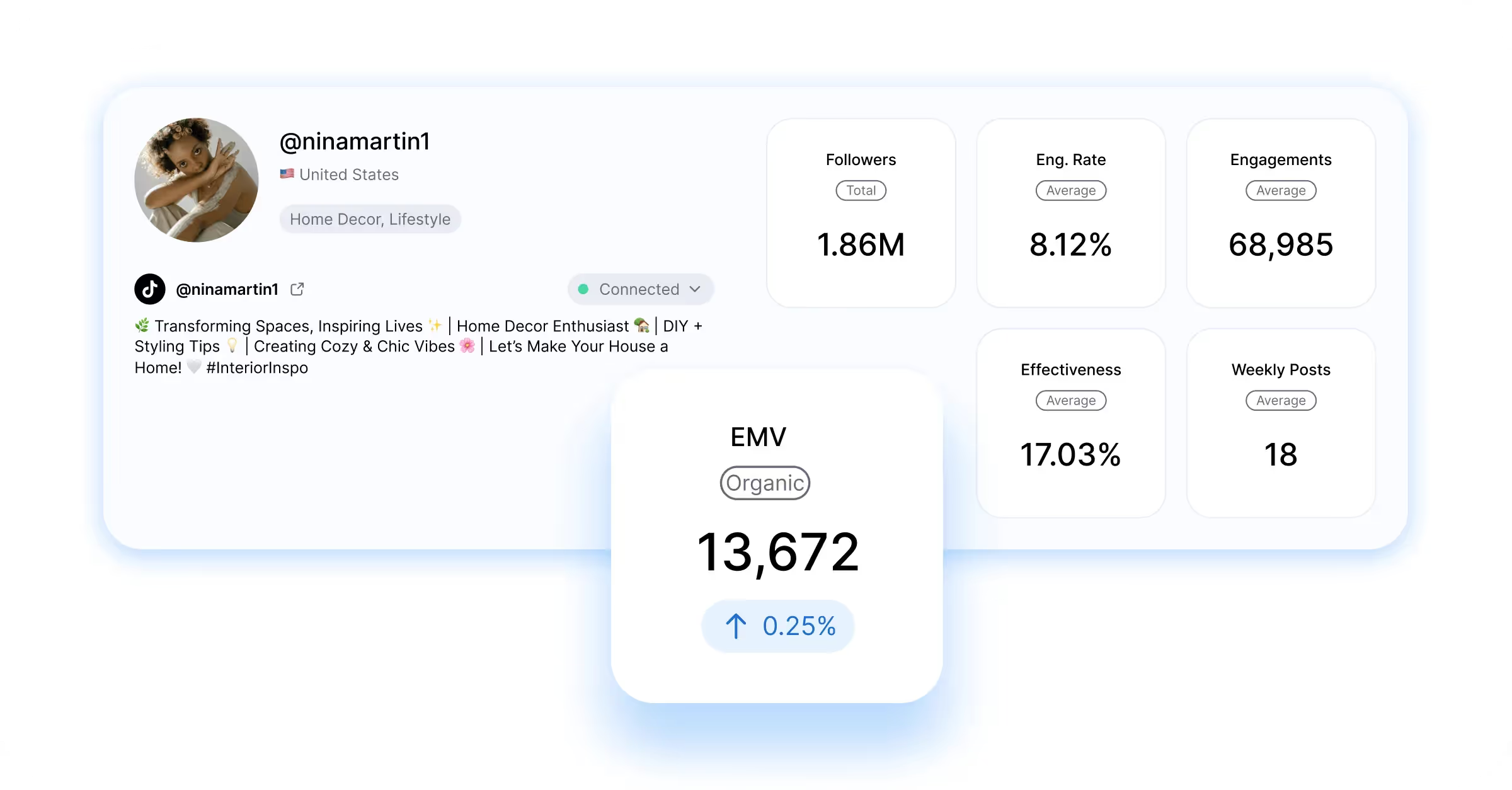
At Dash Social, EMV is used to estimate the impact and value of influencer partnerships through a proprietary algorithm that considers factors such as reach, engagement, and follower growth rate. By standardizing these inputs, EMV enables apples-to-apples comparisons across creators and individual pieces of content, giving brands a consistent baseline for performance measurement.
This is especially valuable when evaluating influencers of different sizes. Nano or micro-influencers (influencers with 100K or fewer followers) often drive strong results due to their highly engaged, niche communities, while macro-influencers (influencers with 100K+ followers) offer broader reach. Because partnership costs, audience sizes, and engagement rates can vary significantly, comparing ROI across these tiers can be challenging.
EMV helps solve this problem by normalizing performance into a single value metric. This allows brands to objectively assess which creators and content types generate the greatest return, empowering more strategic investment decisions with their influencer marketing strategies.
EMV Alternatives (What To Measure Instead)
EMV is an incredibly valuable metric, but it shouldn’t be the only one you’re paying attention to. The following metrics help contextualize performance and its contribution to business goals and success as a whole.
H3: TSI (Total Social Impact)
Total Social Impact is Dash Social’s proprietary metric that shifts the focus from assigning a dollar value to exposure to measuring overall performance impact across social. Because TSI is designed to quantify the total measurable impact your content generates, the metric is performance-based and platform-aware, providing a standardized way to evaluate content success without having to convert metrics. TSI acts as a substitute (or addition) to EMV when the priority is understanding the full performance impact of content.
H3: SOV (Share of Voice)
Share of Voice can serve as an alternative to EMV because it measures competitive brand presence rather than assigning a dollar value to exposure. While EMV estimates the monetary value of earned content, SOV focuses on how much of the total conversation your brand owns within a defined market or industry. SOV is especially effective if your brand prioritizes market positioning over monetary valuation, though in reality, you should be focusing on both.
CASE STUDY
How Summer Fridays Leverages Its Community Created UGC to Increase EMV

Earned Media Value FAQs
How can you increase your earned media value?

Your brand earns media by consistently creating high-quality content that resonates with your audience. The most effective way to increase your Earned Media Value is to produce content that is meaningful, engaging, and inherently shareable. If your content truly connects with your community, it’s more likely to be shared, discussed, and interacted with. As those shares and engagements grow, so does the volume of earned media generated around your brand.
What are some examples of earned media content?
Earned media spans a variety of channels, including blogs, social posts, videos, and other content shared across your website and social platforms. Its true value is realized when audiences actively engage with that content by liking, commenting, and sharing it with their own networks. This amplification is what drives earned impact, making it essential to consistently plan and publish creative, compelling, and highly shareable content.
Are there other ways to calculate EMV?
Measuring earned media is dependent on each brand’s unique goals and priorities. Because every brand may define success differently, there is no single universal formula for calculating EMV. Instead, a variety of metrics and weighting combinations can be used to determine earned media value based on what a brand is looking to track and optimize.